DC at Night

DC at Night

Tuesday, October 15, 2013

The Simple Dreams of Linda Ronstadt

Many people believe that the rock stars of the late 60s and early 70s, fueled by a diet of drugs, alcohol and adoration, engaged in a decade-long series of wild, sex-filled parties after their sold-out concerts. Linda Ronstadt, one of the most popular singers of that period, admits that while the times could be wild, they were not the same for everyone. "Did I try things? You bet I did," Ronstadt says. "But my addiction is to reading. I was the girl back in the hotel room reading and knitting".

Actually reading is much more of the pastime with rockers than you might imagine, Ronstadt explained. "A musician was the one who turned me on to Anna Karenina," she said speaking recently at the National Book Festival in Washington, DC. "The piano players always read; the drummers not so much. The piano player was the guy who had to calm things down. The lead guitar player was like the high-strung pitcher and the piano player was the catcher".

Linda Ronstadt Then: On stage in the 70s

She compared the life of a touring musician to that outlined in seafaring books like those ofHeart of Darkness author Joseph Conrad. "Those books capture how provincial a sailor's life is. The harbors are the same all over the world. You hang with the same scabby old guys. You don't go beyond the harbor. Being on tour is very much like that. There's the bus, and the hotel, and the sound check, and the show, and the dinner, and then the after-dinner playing. And then you do the same thing the next day".

Ronstadt, now 67 and battling the crippling effects of Parkinson's disease that has dictated she will never sing in public again, was appearing at the festival to talk about her new memoir Simple Dreams, which focuses on her upbringing in a musical family in Tucson and the evolution of her career.

"My Dad sang these Mexican standards and folk songs," she told the crowd of fans that packed the huge tent on the National Mall. "I just wanted to be a singer. I didn't want to be a star".

Ronstadt first came to national attention with the band the Stone Ponies and their 1967 hit "Different Drum". She settled in the southern California area and began putting together a new band. She was able to recruit Don Henley on drums, Glen Frey and Bernie Leadon on guitar and Randy Meisner on bass. If those names sound familiar, it might be because those 4 went on to form The Eagles, one of the biggest selling bands of all-time. "They started playing (opening) shows together and regularly blowing me off the stage, but I didn't care. It was great music and I was loving it," Ronstadt said.

She says she is still amazed about those days in Los Angeles. When she was 18, she met a singer/songwriter who was one year younger. His name was Jackson Browne. "I was astonished that someone that young could write songs that well. And the 1st guitar player I met was Ry Cooder. He was up on stage playing his ass off like a demon".

In the 70s, Ronstadt released a series of hits that showcased her versatility such as "Heat Wave","Blue Bayou," "Tumbling Dice" and "You're No Good".

She also had a series of boyfriends, including current Oakland Mayor and former California Governor Jerry Brown. But despite the fact that she raised 2 adopted children, she never married. "I didn't get married. It wasn't important to me. I was a serial monogamist," she said with a laugh. Although Ronstadt enjoyed her time in the rock limelight, she actually pulled herself out of the business to devote time to raising her 2 children, who are now 19 and 22.

Ronstadt said she was inspired to write her memoir after reading other such volumes like the one penned by fellow singer Roseanne Cash. "I thought I would like to write a thank you note," she said. "I wasn't the most talented singer, but I was one of the most diverse singers. I wanted to write about why these musical choices weren't arbitrary. And they certainly weren't career moves".

She did a series of standards arranged by the late, great Nelson Riddle in the 1980s, predating such singers as Rod Stewart and his American songbook. She followed that with a return to her Mexican roots. "That was music I was passionate about. I had to sing it or I felt I would die," she said.

There is a belief that all music stars with hit records make millions of dollars. "That just isn't true," Ronstadt said. She cited an article on her current book tour that portrayed her as squandering a fortune. "The writer wondered why I couldn't afford a $20 million house. Oh gee (hitting herself in the head for emphasis), I must have snorted it".

Ronstadt says the recording industry of her days is a thing of the past. "The record business I knew is completely gone. Now we don't have any gatekeepers. They knew what a good record was". Ronstadt says that while she is not against change, "the price we pay may be much too dear for what we lose".

And while she describes herself as not particularly political, she does have strong feelings about the immigration debate. She contends that like much of America, the golden era of 20th Century music was nurtured by great American immigrant songwriters like George Gershwin. “It was completely created by the fact that we were a nation that was welcoming to immigrants,” Ronstadt said. "We allowed them to come in and find their place. We allowed them to prosper, which is what people from Mexico and Guatemala and El Salvador and Liberia and Libya and all these people would be doing now if we let them. We need to help them find their place. “I don’t know why this country doesn't learn.”

Linda Ronstadt Now: Discussing her new memoir
Of course, she is asked how she feels about the Parkinson's that has robbed her of her singing voice and forces her to steady herself with the aid of 2 walking sticks. Her succinct answer - no regrets. "I had a great career. I had an unusually long run at the trough," she says.

Monday, October 14, 2013

Wild Tales from Graham Nash

If you are a fan of Crosby, Stills, Nash, and Young you should take a moment and thank Mama Cass Elliot, one of the 2 female singers in the hit-producing 1960s southern California group The Mamas and the Papas. Or at least that is what Graham Nash says. Here is the way Nash tells the story of his 1st meeting with David Crosby, a meeting that led directly to the formation of CSN&Y.

In 1966, Nash, then a member of the British Invasion band The Hollies was in California. He got invited to a studio where the Mamas and the Papas were recording. Nash said he definitely wanted to go. "Like everyone else, I wanted Michelle (the other female singer, the stunning Michelle Phillips) badly," he says with a wink.

However, Michelle was busy recording a vocal part, so Nash stood outside the studio talking to Cass. Knowing that Nash was close to the Beatles, Cass asked "What do you think John Lennon would think of our music?" she asked.

He said the sardonic, satiric Lennon would probably make fun of it. "She began crying her eyes out; she had such a crush on John," Nash said. So, feeling badly for what he had said, Nash readily agreed to Cass' suggestion that he come with her to meet someone she was sure he would like.

When he arrived at the apartment with Cass, he encountered a young man in a blue and white T-shirt, laying on the couch, intently, but effortlessly, separating quality marijuana from stems and seeds, all of which was contained in a shoe box.  "That was the 1st time I ever met David Crosby and it was also the 1st time I ever got high," Nash says.

It was also the beginning of what Nash calls "the most rewarding and the most difficult relationship" of his life, a life that Nash examines in his just-released memoir Wild Tales, which he talked about recently at an appearance at the Library of Congress. . "I loved him from the moment I met him. He was himself. He was so irreverent," Nash explains. "I was writing songs with (chords) A, D. and E and I'm out of there. David was writing such intricate chord patterns. He had the words cognitive dissonance and antithesis in the same song lyric. I was writing 'I want you now.'"


Graham Nash Then: With David Crosby at Woodstock
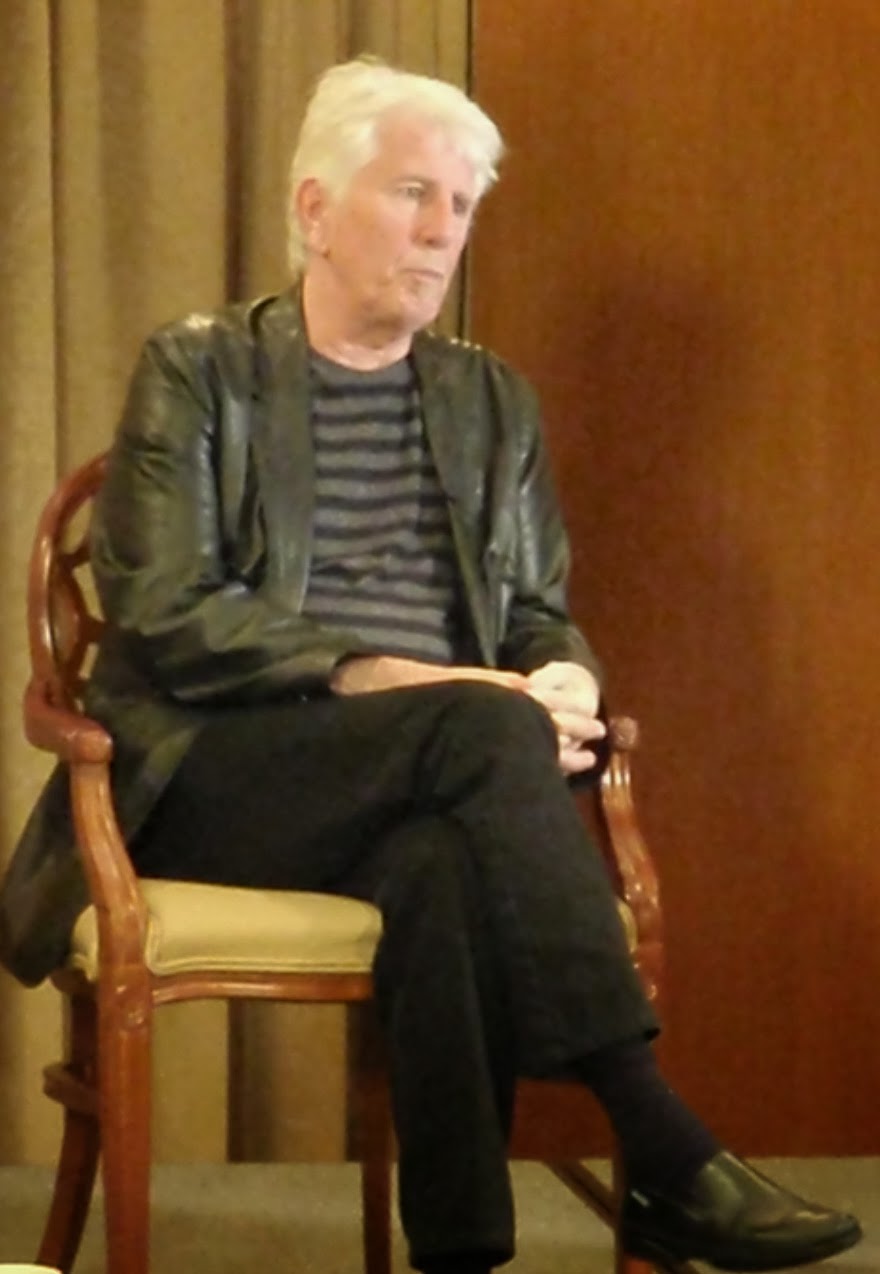
Graham Nash Today: Discussing his memoir at the Library of Congress
Crosby, then a member of the Byrds, introduced Nash to Stephen Stills, who at the time was a member of the Buffalo Springfield along with the enigmatic Neil Young. The trio decided to see how they would sound together. They started with a Stills song "You Don't Have to Cry". After hearing the song, Nash asked Stills and Crosby to sing it one more time. "We then hit that 3-part harmony and we all started laughing. It was great. What a thing to hear. Our sound was born in 40 seconds," Nash said.

"From the moment I heard me and David and Stephen sing, I wanted that sound," Nash said. "So what the hell was I supposed to do? I left my wife. I left my band. I left England and came to America".

But Nash, who will be 72 on his next birthday, readily credits England, his family, and his friend (and later Hollies band mate) Allen Clarke (whom he 1st met in school as a 6-year-old) with his musical beginnings.

"I have a vivid memory of blackout curtains (used in British homes during World War II)," Nash said. "After the war, it was a very strange existence. As youngsters we had nothing to do. At the time, you were supposed to grow up and do what your Dad did. But my mother and father never let me fall for that. I knew from the age of 13 that I wanted to be a rock and roll musician. I've actually been a photographer longer than I have been a musician. But I knew I couldn't get girls with a camera. That wasn't happening. Nobody was saying that's a sexy camera. But a guitar ..."

One of Nash's greatest influences were Don and Phil Everly. He and Clark found out they were performing in their city. "It was April, 1960 and we were dying to met them," Nash said. So they went to the show and then staked out the hotel where they were sure the Everly Brothers were staying. Finally, at 1:20 a.m., the brothers came down the street. Nash and Clark approached them. "They were great. They talked to us for 20 minutes. We were so happy. In many ways, we are all trying to touch the flame of that which we admire".  At the time, Nash never imagined that over the years he would actually get to perform and sing with his idols on several occasions.

Nash said he enjoyed his time with the Hollies, but came to disagree with their musical directions. The group wanted to continue focusing on making hit singles; Nash wanted more. "Being around those (California) people changed me. I learned you could write a song about real stuff and still sell records," he said.

Another seminal figure in Nash's musical development was Joni Mitchell. "How could you live with a genius and not have something rub off?" Nash said of the years he and Mitchell were a couple. In fact, Nash says he feels so fortunate to have found 2 great loves in life - Joni and his current wife of 37 years, Susan. "She keeps my feet on the ground," he said.

And then, of course, there's Crosby. "This guy never ceases to amaze me," Nash said. "He's probably on his 15th life, but I think he has finally realized that he is not invincible".

In fact, an incident involving one of Crosby's escapades was the only thing the publishers of Nash's book questioned. "Legal called me and said I had to check on the story that David sold his Mercedes for crack (cocaine). It seems David wanted to get his car back so he went to the dealer's house and found him dead from a drug OD (over dose). So David stole his pink slip back. When I asked him about the story, David said not only was it true, there was more. He actually resold the car again to get more crack".

Nash said he is constantly grateful for the life he has lived. "My father was dead at 46 and so sometimes, I feel I'm living 2 lives," he said. He said a few years ago, he asked his mother why she and his father had been so supportive of his choice to risk all with music. "You're living my life," she told him. After she died, Nash was playing a concert at Carnegie Hall in New York. "I scattered some of her ashes there he said, adding that he still does that whenever he performs on a stage he believes his mother would have liked to have sung.

As for the political nature of much of his songwriting, Nash again cites Crosby. "Crosby has always spoken truth to power. I've always been for the underdog. I think the media wants us to focus on (Justin) Bieber's monkey or the size of Kim Kardashian's ass, but music is so much more than that," he said.

Nash said that the political stands both he and the various configurations CSN&Y have assumed over the years, have effected the group's popularity. On their last tour together during the George W. Bush years, the band played a song "Let's Impeach the President". In some southern venues, that stance caused some of the crowd to walk out.  "I mean they have the right to walk out, but Holy Toledo, if you buy a ticket to a Crosby, Stills, Nash, and Young concert, what the heck do you expect?"

Like so many other great songwriters, Nash cannot offer a formula for what he does. "Once I write a song, it has to make it through me. I only write for me. I have to be moved before I can write," He explained. He did, however, note with a laugh, one time when the process was speeded up. "I was at a dinner party and somebody said, 'you're supposed to be a big star. I bet you can't write a song before you go," Nash noted. So he left the room and came back in about 20 minutes with a completed version of "Just a Song Before I Go".  The song reached #7 on the Billboard charts in 1977, making it CSN&Y's highest climbing hit. "Yes, I really do love what I get to do," Nash repeats. "I know so many people that have had their dreams crushed, but I get to live mine everyday".

Monday, October 7, 2013

Soaring Sonic Waves Unite Brian Wilson, Jeff Beck


Beach Boy Brian Wilson on piano with guitar virtuoso Jeff Beck (in white with white guitar)
In the history of rock, there have been some odd concert pairings. In 1966, I saw The Who, in the middle of their smash-their-instruments phrase, precede the cuddly British pop idols Herman's Hermits. In his early days, Bruce Springsteen opened for both Chicago and Anne Murray. Perhaps the strangest combination of all involved the 8 dates when Jimi Hendrix set the stage for the Monkees and their screaming teenage fans.

On 1st glance, many felt that same way about the announcement that Brian Wilson, the songwriting leader of the Beach Boys, would be touring with rock fusion guitar god Jeff Beck, who began his career so many years ago in The Yardbirds, the same British Invasion band that produced Eric Clapton and Jimmy Page.

But actually there are similarities between Wilson and Beck that make the pairing look sensible. Beck has long professed to admiring the surf sound, a sound which Wilson is credited with perfecting. Both he and Wilson have a costly collection of restored, classic cars. And both perfectionists have turned their backs on the process of making hits, instead creating music that pushes boundaries and establishes new heights of groundbreaking artistry.

But no one really had any idea exactly what to expect when two of rock's most enigmatic geniuses actually took the same stage, not just in separate sets with their bands, but also in 2 mini-sets together.

Last weekend, the tour came to DC's Warner Theater and I can attest that the intriguing pairing not only works, it works brilliantly, providing some of the most glorious music that will be heard on any stage this year.

Wilson opens each concert with a hour-long set of Beach Boys favorites he wrote. He is joined by his 8-piece band and 2 members of the original Beach Boys grouping, Al Jardine and David Marks. The last time Wilson appeared in the DC area it was at an outdoor concert for the Beach Boys 50th Anniversary Tour. On that night, the now 71-year-old Wilson, buried back on the stage behind his piano, seemed ill at ease, oblivious to much of what was going on around him and even missing many of the musical notes he had so painstakingly composed in his youth.

But it was a much different Wilson on the Warner stage. With his piano now positioned front stage, he often awkwardly, but animatedly, waved his arms, spoke to the crowd, and even provided background for some of the classics that have been thrilling fans since the early 60s.

The Wilson portion of the show was divided into 3 segments. The ensemble, which was far superior to the group that Beach Boy and Wilson cousin Mike Love put together for the Anniversary jaunt, provided the perfect harmonies and instrumental backing for the 4-song hit segment that opened the show on an upbeat note -"California Girls" and "Do It Again" segued into 2 classic car numbers "409" and "Little Deuce Coupe." That was followed by a 11-song string that included many of Wilson's more complex numbers such as "Heroes and Villains" and "Pet Sounds". Finally, a symmetric, 4-song segment of smashes - "Good Vibrations", "Help Me, Rhonda", "I Get Around", and "Fun, Fun, Fun" - brought the crowd to its feet and closed the Wilson-only portion of the night..

The stage was quickly cleared and Beck, in his trademark sleeveless shirt, and his 4-piece supporting group took the spotlight. For an hour, Beck, 69, amazed and astounded as he steered the crowd through a series of searing, soaring, and, at times haunting and hypnotic, instrumentals. Each dynamic song was a highlight in and of itself, but for those looking for more accessible numbers, Beck included  magnificent versions of "Little Wing" by Jimi Hendrix and his show-closer The Beatles "A Day in the Life". During the middle of the set, Beck and his band were joined by Wilson and the singing members of his group for intriguing explorations of 3 melodic Wilson songs - "Our Prayer", "Child Is the Father of the Man", and "Surf's Up". After a fast-paced take on the blues standard "Rollin' and Tumblin'" and the aforementioned "Day in the Life," Beck and his band exited the stage.

The show concluded with 2 encores performed by all the members of both bands. In the 1st, the conglomeration offered its uptempo take on 2 classic California surf scene classics - "Barbara Ann" and "Surfin' U.S.A," with Beach Boy vocals augmented with dazzling Beck solos. The final encore was a subdued, beautiful rendition of the Irish standard "Danny Boy".


Before the 18-city tour, which will conclude on the 27th of this month with a show at the University of Akron in Ohio, Beck, in a Rolling Stone interview, said the pairing would feature "classic surfing safari music and this weird stuff that I do," but promised it would "sound like it's all of one accord."

And in the nations capital, Beck, Wilson, and their talented band mates delivered on that promise. For while Wilson relies on layered harmonies to produce one-of-a-kind pieces, Beck is wedded to the same idea, except that he uses strings (he was joined by a 2nd guitar player and a violin virtuoso) instead of voices to deliver musical innovation that sounds so much greater than the sum of its sometimes rocking, sometimes ethereal parts. And both separately and together that makes for a night of fun, fun, fun indeed.

Sunday, October 6, 2013

A Glimpse at Some Upcoming Supreme Court Cases


Here is a sampling of what is at stake in the new U.S. Supreme Court term, which begins tomorrow. 
  • Privacy and the Police (can a roommate waive your 4th Amendment right to protect your residence against illegal search and seizure?)
  • Abortion 1 (can people who don't have business at a reproductive health care facility - most often abortion protesters - be kept from congregating within a buffer zone around the facility?)
  • Abortion 2 (how far can states go in restricting abortions by enacting laws ostensibly directed at making abortions safer?)
  • Campaign Finance (should billionaires be allowed to give massive dollar donations to single candidates, which would leave those candidates extremely grateful to those large donors?)
  • Housing Discrimination (In the case of Mt. Holly NJ, the court will be asked to rule on disparate racial impact in housing)
  • Affirmative Action (the court will consider whether states can ban consideration of race in university admission)
  • The Future of Unions (a case which could decide the future of neutrality agreements where employers agree to remain neutral on a union attempt to organize its workforce)
  • Clean Air (a decision on whether the federal Environmental Protection Agency regulates downwind pollution too much and doesn't defer enough to states to solve the problem)

Saturday, October 5, 2013

Public Prayer Dispute Heads to Supreme Court

Next month, the U.S. Supreme Court, whose new term begins Monday, will hear a case about public prayer that could change what is and what is not permitted when it comes to praying before official public meetings of groups such as town councils and local school boards.

Currently, in the town of Greece, NY, the town governing board opens its meetings with a Christian prayer. However 2 town residents have argued that the prayer sends a message to non-Christians that they are unwelcome at board meetings and that the board does not properly represent non-Christian concerns.

A district court upheld the town board's practice, but, on appeal, the 2nd U.S. District Court of Appeals, in a unanimous 2011 decision, found that the Greece's governing body prayer practice was unconstitutional. The town appealed the decision to the Supreme Court, which agreed to hear the case.

"There is a coercion and a sectarianism in Greece that we find Constitutionally problematic," says the Rev. Barry Lynn, one of the attorneys for the plaintiffs. "With the prayer, you better act like you believe it or you will be viewed as an outlier. People feel compelled to participate in a matter in which they disagree."

Even though the Supreme Court has previously found that legislative bodies can begin a meeting with nonsectarian prayer, Lynn contends that the prayers in Greece are Christian, a premise which violates the idea of separation of church and state specified clearly in the documents on which America was founded.

Lynn contends that for 10 years, Christian clergy have offered virtually every prayer that has opened the town meetings in Greece. Research shows that two-thirds of the recorded 120 prayers contain specific references to Jesus Christ or the Holy Spirit. During that time only 4 non-Christian payers have been given, two by Jewish laymen, one from the chairman of a local Baha'i congregation, and another from a Wiccan priestess.

In their argument, the plaintiffs contend that the sectarian prayers are also coercive. They say that the town meetings are different from state legislatures or Congress sessions, which people visit to observe from the gallery. Town meetings, however, are the only place residents can go to participate in their local government and serve as the only chance residents have to petition the local government to take action on matters that directly impact their lives such as zoning ordinances or requesting better neighborhood police protection.

In their legal position, the plaintiffs contend that if the Supreme Court issues a ruling for the town of Greece, it would be permitting the government to endorse Christianity above all other faiths, a move prohibited by the First Amendment, which states, "Congress shall make no law respecting an establishment of religion, or prohibiting the free exercise thereof ..."

Lynn says that people should not assume an attitude of why should I care if a town in upstate New York wants to open its meeting with a Christian prayer. "Prayer does matter," Lynn says. "If you believe in a deity and pray to that deity, then it is not trivial".

The Greece v. Galloway case may prove to be only one wide-reaching religion case the Court hears this term. Legal experts think it may agree to also hear Hobby Lobby v. Sebelius. In that case, Hobby Lobby, a large craft retailer known for offering all types of craft-centric material, is balking at providing certain types of medical care for its employees, care that the firm owners contend violates their religious beliefs.

Hobby Lobby has 559 stores across the country and brings in $3 billion in revenue each year. It is owned by the Green family - devout Christians who believe that human life begins at conception and that using certain types of birth control is against their beliefs.

The Greens have asked the federal government to exempt their for-profit corporation from the Affordable Care Act's requirement with businesses with more than 50 employees offer health plans covering contraception. Opponents counter that the firm is trying to impose its religious beliefs on its 22,000 workers.

"Just because you have a do-it-yourself pink Pelican key chain, that doesn't make that a religious icon and that does not make you a church," Lynn says.

Friday, October 4, 2013

Friday Flashback: Taking the Stand to Make a Stand

Tommie Smith and John Carlos (rear)
This post 1st appeared in The Prices Do DC on Oct. 4, 2011. Enjoy our back in time trip

It is one of the most dramatic, revolutionary pictures of all-time. Two young black men, just moments removed from winning track medals in the 1968 Olympics, standing on the medal-platform, heads down, a single back-gloved fist raised in the air in silent protest.

And tonight, 43 years later, John Carlos, one of those historic figures, appeared at the Busboys and Poets bookstore along with sports writer Dave Zirin,to discuss the book The John Carlos Story they had co-written.

In a lengthy, highly entertaining, often hilarious monologue, Carlos detailed his life which led him from the streets of Harlem to his historic moment in Mexico. Initially, he said, there has been much discussion of a boycott of the 1968 games by black American athletes to protest conditions for blacks here and in white-dominated African countries.

That boycott was to receive full support from Civil Rights leader Martin Luther King Jr.  In fact, Carlos said he had a chance to meet with King, who was then embroiled in a trashmen's dispute in Memphis, and asked him why, with death threats escalating, he continued his crusade.

Carlos said Dr. King very simply told him: "John, I have to go back to stand for those who won't stand 
for themselves and I have to go back to stand for those who can't stand for themselves."

Within months, Dr. King was assassinated and the boycott idea was dead. However, Carlos and his running mate Tommie Smith vowed to take some kind of a stand. And so, when Smith finished 1st and Carlos 3rd in the 200, an eternal visual symbol of protest came to be.

Interestingly, while all the focus was on the gloved raised fists, there were other aspects of the protest. Both athletes wore necklaces for lynchings of blacks in the South and  stepped up to the podium without shoes to call attention to the plight of the poor. Carlos further left his track suit unzipped in a sign of solidarity with oppressed workers.

Zirin, who is one of the most socially conscious sports writers in America today, said he had 2 major questions when he and Carlos started the book.  The first was - why did you risk what you did? (and indeed the  fallout was nasty and long-lasting).  Zirin indicated that perhaps the answer to that could best be explained in a quote on the front cover of the book:"How can you ask someone to live in the world and not have something to say about injustice?"

The second, and perhaps even more important question, Zirin said is - why does what Carlos did still seem to matter so much and resonate so loudly? "We still have injustice today and it's still important for people to take a stand. John did that. And he paid for his stand, but he says he really had no other choice - it was the right thing to do," Zirin said.


Carlos signing his book.

Travelers' Tip:
You have to always be ready to part with your money.  I swore I wasn't going to buy the book, but after hearing Carlos and Zirin speak, I felt I had too.  I had them sign it to my grandchildren Audrey and Owen. I hope, like Carlos, if they find a time in their lives when a stand needs to be taken, they will have the courage to do the right thing regardless of the costs.

Thursday, October 3, 2013

Zip It and Put It Away

Today, we are starting something new in The Prices Do DC. From time to time, we will be featuring guest posts from other writers. And what better way to start than with the 1st solo piece for publication ever written by my concert-going partner and wife of 40 years, Judy Snyder Price.

Hall and Oates on stage in DC

The other night, my husband and I went to a Hall and Oates concert in DC. In case you don't know who Hall and Oates are, they were a huge band in the 80s with hits like Private Eyes, Kiss on My List, Maneater, and I Can't Go For That (No Can Do). 

Now, as much as it pains me to say it, being  from the 80s (which I still think of as relatively new music) makes Hall and Oates actually an oldies act. That's why I was surprised to see so many younger fans in their late 20s and 30s at the Warner Theater show. I mean most of the crowd where we were sitting was younger than my son, who turned 40 earlier this year.

DC patrons have a deserved reputation for being extremely loud in restaurants and bars. They love to talk about politics and their jobs, about what they are doing and what they have done and what they are going to do and, from what we overhear, mostly anything else about themselves. We're not eavesdroppers and we don't work for the NSA, but you can't help but hear if you have 2 ears, even if they are 62-years-old each. When conversation is on our "list," we avoid these places.

Anyway, as the 8 p.m. start time of the concert approached and hundreds of last-minute arrivals (an apparent trait of the 20-to-late-30s crowd) found their seats, it made for an extremely loud theater. And you know it's loud talk if you can hear the people 4 rows away over the guitar tech checking the stage volume.

I figured that once the concert began, the chatter would stop and everyone would sit back and enjoy the show. Boy, was I wrong.

Maybe it's an age thing, but I think there's a problem with enjoying entertainment and young people today.

Once the band took the stage, many in the audience continued their conversations. In fact, some of them talked throughout the entire concert. It was annoying, distracting, and totally uncool for people who, at least from the way they were dressed and the expensive drinks they were drinking, think it is very important to be cool.

This generation also has an addiction to their cell phones. Many found it necessary to text the entire time. I know about multi-tasking; I do it too. But in a dark concert hall, the lights from cell phones can be very distracting when they are everywhere around you. Add the constant trips to the bar and then the bathroom and these interruptions really got to me.

I see it this way. If you want to talk to your friends, do it before or after the concert. If you need to text, do it before or after the concert. If you need a drink, get it before the concert starts. If you have to use the bathroom, do it before the concert starts and if you can't hold it until after a 90-minute concert ends, then maybe you drank too much.

My son says I am an old fuddy-duddy. Maybe I am, but when I go to a concert, I want to be able to hear the music, not somebody's conversation about what John or Mary did or didn't do last night. So, to all of you concert goers who fit the above description, I say zip it and put it away!

Monday, September 30, 2013

A Film Look Inside the DC Beltway Sniper Spree

Whenever there is a horror that displays the darkest sides of human behavior, there is always the question why.

Eleven years ago this month, the DC area was terrified by a series of coordinated shootings that left 10 innocent people dead. That rampage was perpetrated by one man, John Allen Muhammad and one teenage minor, Lee Boyd Malvo. The pair drove from murder site to murder site in a customized blue 1990 Chevrolet Caprice that allowed Malvo to fire unseen from inside the car trunk.

This past weekend a new film Blue Caprice, inspired by the Beltway sniper attacks, premiered in Washington. The 93-minute movie attempts, in a surprisingly tasteful way given the subject matter, to reveal the social and psychological flaws that drove Muhammad, who was executed by lethal injection in 2009, and his protege Malvo, who is serving 6 consecutive life sentences with no chance of parole, to commit their hideous killing spree.


Following a Saturday night showing at the West End Cinema, lead actor Isaiah Washington appeared in a Skype interview call to answer questions about the film from the media and audience members.

"Today we all are suffering from cultural violence. Everyone is victimized; we are all touched by it and rendered powerless," Washington said. "There's nowhere to run and hide. We want people to watch this film and go home and talk about it. Violence happens over and over and over and over again. We have to talk about it. We can't walk away shrugging our shoulders".

Washington said everyone involved with the film wanted to present an accurate portrait of the perpetrators of violence, but not glorify them or even create sympathy for them. He said that when he was researching the real John Allen Muhammad he found many psyche flaws and personal traits that would "chill you to the bone".

There are many themes examined in the film, but 5 stand out. They are:

  • the horrific actions that can come from alienation and isolation
  • the damage to a young person victimized twice, first by no parenting and then even more drastically by bad parenting and leadership
  • what can happen when the psychologically damaged feel they are completely powerless
  • the desensitizing impact of a gun culture
  • and the effects that ensue when people become complacent with that cultural violence
Washington on the Skype screen
Only half-jokingly, Washington said that playing such a dark role left him "on a psychiatrist's couch for a few weeks". He said one of the most difficult scenes for him to play was leaving his protege and film "son," tied up and abandoned in the woods. "What you see in the film is an actor running away to cry. I told the director that I would only do that scene once," the actor said.

Washington was effusive in his praise for 20-year-old Tequan Richmond, the actor who convincingly plays the severely damaged, fictionalized version of Malvo. "This is a 20-year-old who gets it," Washington said. "I felt like I was curbside watching a star being born".

The decision not to show any of Muhammad's Islamic affiliations was deliberate on the part of filmmakers.  
"We didn't want people to go down that rabbit  hole," Washington said, explaining that the film is about characters, not any views of Muslims.

"We wanted to speak on some very difficult subjects. And if we got it right, if we told the truth, we might change some minds ... maybe even save someone," Washington said.

Tales, Tidbits, and Tips
As with any movie based on real-life events, the impacts are somewhat more personal than a story of pure fiction. For example, our son Michael was living in the Washington area at the time.  He even got gas at one of the sites of the shooting. I will always remember the worry for his safety I felt at the time. Even though she is an avid movie buff, Barbara Rew spoke for many area residents when she said "I don't think I can see this film after having lived through the experience". Even non-DC-area residents who had some connection share Rew's view. "I won't be watching this movie. I was terrified when we went to Maryland. We used Rt. 40 instead of 95; it was too scary. Very few news reports have scared me like this one," says Jersey resident Karole King.

Sunday, September 29, 2013

The Crier Creates a Humorous Look at DC Headlines

There is no question that writing clever headlines is an art, but can the headlines themselves be considered art. Well for DC-area artists Natalie Campbell, Bryan Minnich, and Martine Workman, the answer is a resounding yes.

Working with a group of fellow artists, the trio has produced the satiric, tongue-in-cheek newspaper (in different size versions) The Crier.  Half artist mag, half local rag, the issue was edited and assembled via submissions, and a series of prints were produced at Pleasant Point Workshop in the Shaw-Howard section of the city to create an interactive installation that was unveiled this weekend.

With headlines like Excuse You Is That My Bag (a takeoff on the ubiquitous DC Metro message - Excuse me, is that your bag?), Tourists Disappointed Washington Mall Is Not a Mall, and The Four Best Conspiracy Theories About the Scaffolding on the Washington Monument, The Crier cleverly pokes fun at DC, while at the same time capturing the zeitgeist of the nation's capital.

To add verisimilitude to the tiny paper (whose banner proclaims Free In DC, $1 elsewhere), the inaugural issue (3 are planned), includes ads, classifieds, maps, cartoons, and other items you might find in a street paper.

Part of the project was a playful attempt at "reducing the news to a manageable personal size" that could then be distributed, says Campbell, who explained that both she and Martine had been using tiny newspapers in their art displays. "We wanted to do something hyper-local that played with different forms," she added.

When she lived in Washington state, Martine actually published a small art paper for the 800 residents of that tiny community called Twisp. "People loved it," she said with a laugh.

Minnich, a graphic designer, is no stranger to humorous publications. He actually produces his own magazine Popular Demand. But then, he also publishes a 2nd magazine, Brute, which is designed to despise and comment negatively on everything Popular Demand publishes. "Brute is a bully, but it lets me get all my hate out," Minnich explained.

Probably the most interesting piece in the installment is the setup with printed sheets of The Crier that seem as if they are actually coming off a printing press. And if you like it, it is for sale. All you need is $1,000 and a big vehicle to get it home.

Tales, Tidbits, and Tips
Campbell, Martine, and Minnich, all agree that the Pleasant Point Workshop is one of DC's most happening art operations. To learn more about the kinds of things that go on there, click here.

Friday, September 27, 2013

Friday Flashback - The Thrill of Victory, The Agony of Defeat

This post 1st appeared in The Prices Do DC on Sept. 28, 2011. Enjoy our back in time trip


In this modern era of spoiled superstars, greedy billionaire owners, and crazed, alcohol-fueled fans  who think it's OK to assault someone simply for wearing the jersey of an opposing  team, it's difficult to remember why I once made sports such a cornerstone of my life. Then something happens to temporarily restore that lost magic, the idea that that anything - even the impossible - can occur on an athletic field. And tonight provided one of those times.

It began with a call from my former college roommate Steve Ferrara, who, like us, lives in the DC area. Now for the purposes of this story, there are 2 things you need to know about Steve - he pronounces a sentence like park your car in Harvard yard as "pahk your cah in Hahvard yahd" which, of course, means he is a die-hahd Boston Red Sox fan

Steve's Red Sox were  going to to be playing the Baltimore Orioles in that most exciting of sports situation - win or be done: capture the last game of the season and they would still have a chance to be in the Major League playoffs; lose and they could be going home to live with the stigma of the greatest collapse in baseball history. So when Steve suggested that Judy and I join him in Baltimore at the game, I readily agreed, especially since he said he would pick up the tab for the tickets.

My warm feelings for my former roommate soared when he asked if  we would mind, since the game meant so much to him, sitting directly behind home plate in the $99-a-ticket section. Object to those seats? Yeah, right.

So that's how I found myself sitting in prime home plate seats on a night that would make baseball history. Although all the 6 divisional championships had been decided, there was still a question of who would be the wild card teams. In the American League, it would either be the Red Sox or Tampa Bay, who were playing the Yankees in New York. The National League wild-card would be decided in games between the Philadelphia Phillies (my team) and the Atlanta Braves and St. Louis and Houston. In short, the setup meant that fans across the country would be watching the action on the scoreboard as intently as they would be watching the action on the field.

In Baltimore, the action on the field see-sawed; first the Red Sox were up, then the Orioles, then the Sox again. Initially, the scoreboard story was a different matter.  The Yankees stormed to a seemingly insurmountable 7-0 lead over Tampa Bay.  It looked Steve's Sox were headed to the playoffs. But then, as can happen is sports, the baseball gods decided to change the story line.  Miraculously, Tampa tied the Yanks, sending  the game into extra innings. 

And just to prove that their powers were not limited to 1 city, those same gods decided to intervene in Baltimore, too. The scene was set. The Red Sox were 3 outs away from victory. Their ace relief pitcher was on the mound. First batter; 1 out. Second batter, 2 outs. Steve, along with the 1000s of other Red Sox fans in Camden Yards, jumped to their feet , shouting, pleading, imploring their team for just 1 more out. Next batter.  A double to center. That's OK, no harm. Next batter ... oh NO, back to back doubles, game tied. Still, it's OK. One more out and we'll go to extra innings and win there.  The pitch ... the batter swings ... a sinking drive ... the left fielder, glove extended, flys toward the ball ... he'll get it ... he'll get it ... he's got it ... no, he doesn't ... a single ... the winning run scores .. game over ... Sox lose.

Stunned, slumped, but still standing, Steve listened to the explosion of joy from the Orioles players and fans.  He looked at his dejected Red Sox as they slunk off the field and back to the locker room.  It couldn't happen this way; it shouldn't happen this way. But it did. No matter how many televised replays, the outcome would always be the same - Orioles win. And, in a manner of minutes, it got even bleaker. Word began circulating around the stadium - Tampa Bay had accomplished the impossible; they had come back to beat the Yankees in extra innings.  The Rays, not the Red Sox, would be playing another day.

So, for Steve and the rest of the Red Sox nation, there was only one option - wait until next year.  But then that may be the true lesson of the night.  In sports, unlike life, there is always a next year.

Travelers' Tip:
If you ever attend a season-ending game at a stadium and you plan on eating, you should be prepared to amend your foot choices. When we ordered hot dogs, we found out that the dogs were fine, but the concession stand had run out of rolls. No problem - we switched to burgers. Then we ordered sodas and discovered the stand was out of diet drinks, but did have root beer. And, by the end of the night, there were no cups. Oh well, there is always next year for those first-food choices.

Thursday, September 26, 2013

Midnight in Mexico: Death, Despair, and Hope

Corchado reads from his book
Can a broken promise lead to a personal death threat? Well, for journalist/author Alfredo Corchado it not only could, it did.

When Corchado first started covering Mexico in 1994 for the Dallas Morning News he promised his mother he wouldn't report on the Mexican drug trafficking and its deadly cartels, which have been blamed for more than 100,000 deaths and disappearances in cities, towns, and villages south of the border.

But as bad financial conditions began to reduce the Texas newspaper's Mexican staff, Corchado found himself unable to fulfill his promise. He had to cover the drug industry. But he kept that news from his family. "For the longest time, I didn't tell my parents what I was doing. I didn't want them to worry," Corchado says.

However, the cover-up unraveled abruptly in July of 2007. Corchado remembers exactly what he was doing when the call came that would change his life. He was preparing for a dinner celebration and watching people outside his apartment. A light rain was falling. The Eagles hit "Hotel California" was playing in the background.

His cell phone vibrated. It was bound to be work, Corchado thought. He answered the call. "And that was the last time I felt completely safe in Mexico," he says.

On the other end of the call was a high-placed American source well-known to Corachdo. "They (a cartel) plan to kill an American journalist within 24 hours," the always-reliable source said. "You are one of them. Stop pissing them off." The journalist says his first thoughts were to rush to hide in the bathroom or in the nearest closet.  "Had I been betrayed?" he wondered. He then figured he could "get to them and tell them this isn't personal. This is just journalism". Finally, he decided to leave the country and take a residency year at Harvard University. While there, he came up with the idea for his first book titled Midnight in Mexico: A Reporter's Journey Through a Country's Descent into Darkness.

Corchado appeared at the National Book Festival sponsored by the Library of Congress last Sunday to talk about the book and the future of Mexico.

While Cochardo writes about the drug problems and his death threat, the book is much more. "It's really an argument between a mother and her son," he said, with Corchado having more faith in Mexico's future than his mother who was born there.

It is also an account of a struggle for identity, Corchado, who was born in America, admits. "It is written by someone who feels hopelessly American in Mexico and hopelessly Mexican in America," he said.

Then there is the universal theme that has been explored since Homer's epic The Odyssey - the search for home.

And finally, the book is "a poem to the tragedy and beauty of my homeland," Corchado maintains. The title refers to the idea that no matter how dark it is at midnight, there is always hope for a brighter morning. "Day by day, you see the best of Mexicans. You see their resilience," Corchado said.

Corchado firmly believes that it will be the women who will save their country. As proof, he cites the example of a group of mothers who used tragedy to bring promise. In one town, cartel gunmen burst on to the grounds of a wrong home, massacring all the teenagers who were having a party there. After the burials and with hearts broken, the mothers of the town banded together to create an American-style football program. "They were going to try to build a community with the blood of their own children," Corchado said. "They were going to use the football league to get kids away from the reach of the cartels". And, so far at least, they have been succeeding. With rag-tag equipment and a quarterback who had been shot 3 times, the town's team has been able to compete at a championship level.

"Stories like this is what gives people hope. You see people go through the lowest moments of their lives and then go on," said Corchado, who told the crowd that by using common sense and the power of his U.S. passport he will also go on reporting on a Mexico he has grown to love.

Tales, Tidbits, and Tips
This report on a first-time author concludes our 5-part series on the National Book Festival. We hope our series captured some of the flare and flavor of the annual 2-day event. But of course, with more than 100 authors attending there is so much we couldn't see and report on. If you are a book lover, you really should try to make the festival next September. If you do, stop me and say hi. I'll  be the one with a notebook beaming that, as an avid reader, I get to write about such a great event.

Wednesday, September 25, 2013

A Vet Dishes on the National Book Fest

Brad Meltzer
With almost a dozen New York Times best selling books, many of them set in Washington, Brad Meltzer is no stranger to the National Book Festival, sponsored annually by the Library of Congress, and the DC area.

That was why, when he appeared at the Book Fest last Saturday, he felt like it was a homecoming of sorts.  It was also why he wanted to let his fans, hundreds of whom crowded into the Fiction and Mystery tent, in on the real reason why so many authors always attend the 2-day celebration on the National Mall of all things books.

And the secret?  Authors are offered a special breakfast at the White House. Meltzer recounted his first 1600 Pennsylvania Avenue dining experience. "I was sitting with (British fantasy writer) Neil Gaiman and Salmon Rushdie. And Neil and I are such geeks we were talking about Superman".

Meltzer said he did participate in one White House tradition. "The napkins disappear like crazy and I still have mine," he said.

Later, Meltzer was invited to a special lunch in the residential part of the White House. He found himself seated next to Barbara Bush. On the table in front of him was a beautiful, hand-written seat assignment card embossed with White House designs. Mrs. Bush leaned toward him and told Meltzer that first-timers often made off with the cards. "Oh, those novices," Meltzer said he told Mrs. Bush. "Hey," he called out while pointing, "Look, there's Ruth Bader Ginsburg". As Mrs. Bush turned, Meltzer pocketed his name card. "Still have that, too," he said.

Meltzer in a one-man media empire. In addition to his political thrillers, he has written two best-selling books for young people, one entitled Heroes for My Son and the other Heroes for My Daughter. He has worked on Green Arrow, Justice League of America, and Buffy, the Vampire Slayer comics. He also hosts the History Channel series Brad Meltzer's Decoded.

The prolific content producer was also one of the 1st authors to fully utilize the internet for promotion. Since much he has placed on line goes into far more depth about his writing than he had time to offer in the 45 minutes allotted to him at the Festival, we will use some of his own website postings to tell more about Meltzer and his books.
Tales, Tidbits, and Tips
While I like Meltzer's thrillers and am looking forward to his 10 greatest mysteries Decoded book coming next month, as a former teacher, I am most appreciative of his Heroes for My Son. In my last year of teaching, I used the book in my classes for seriously at risk students, some of whom were repeating 10th grade for a 3rd time. Most of these students were engaged and inspired by the stories in the book. I'm sure your children or grandchildren would be, too.

Tuesday, September 24, 2013

A Hilarious Take on Titles Rejected for Tall Tales Told

When Chris Buckley speaks, everyone laughs
Author Christopher Buckley has a big problem. Recognized as one of America's most humorous satirists, he says it is getting harder and harder to make stuff up that is funnier than what is really happening in America today.

For example, take one of Buckley's latest book tours. Here is how he described one incident from that tour to a tent full of fans this past weekend at the National Book Festival, sponsored by the Library of Congress.

"Well, you know those book blurbs. Sometimes, I just make them up. I had written that I had worked for every president since William Howard Taft (1909 to 1913). So I had an AM drive-time interview. Now, AM drive-time is not really the occasion for Socratic dialogue. You have kind of a sliding scale of interviewers.  At the top you have Terry Gross of NPR and then, down at the Jurassic level, you have AM talk show jocks. I got to the studio and I saw the DJ speed reading my book jacket for an in-depth interview."

Before they went on the air, the radio jock asked him: "So, you used to work for William Howard Taft?"

"I thought, oh what the hell, so I said, yeah."

"Can we talk about that?," the DJ asked.

"And we did," Buckley said, as the crowd laughed uproariously. "Needless to say, I wasn't asked back on the show, but it was worth it."

Buckley said that with so many books coming out each year (400,000 he said, with half of them written by Joyce Carol Oates, who was speaking after him) it was becoming more and more difficult to come up with a good book title. He said he was having such a problem with his new book, which he promised, although he wouldn't talk about it, "was very reasonably priced and attractively packaged".

Titles are supposed to mean something, Buckley contended. "Like when I saw 50 Shades of Gray, I thought it was about decorating. Boy was I in for a surprise," he said. Then there are the foreign sales to be considered. When John Steinbeck's classic Grapes of Wrath was released in Japan, the English title translation said Angry Raisins. "I wonder how Moby Dick made out?" Buckley rhetorically asked.

For the next 30 minutes or so, Buckley took the crowd through the process of trying to come up with a name for his new work of previously published essays that his publishers would accept.

His 1st suggestion was Want to Buy a Dictator? That title came from an article that he wrote for Forbes magazine. Here's how Buckley tells the tale.

"When the Soviet Union was breaking up and Russia was in financial trouble, I thought about (their former leader V. I) Lenin, who was displayed in his tomb. You know, kind of the Sleeping Beauty from Hell. So I decided to write a false story about them (the Russians) trying to auction off Lenin's corpse for hard currency. First, of course, I had to come up with a reasonable price for a dead Commie dictator. $15 million seemed about right"

"When we published the story, the switchboard lit up like a Christmas tree so we went home so we wouldn't have to lie. That night I was watching Peter Jennings (on the nightly news) and he was talking about (the Lenin story)"

"The next morning, I got a call from ( uber-rich magazine owner) Steve Forbes. Now this was the guy who signed my check. It was pretty early for Steve to call. In fact, Steve Forbes had never called me. He said the Russians are going ballistic. They were calling me a brazen liar and an international provocateur ... and I thought ... cool."

But that wasn't the end of the story. In reality, the Kremlin became deluged with offers for the dead Lenin. One Dallas, Texas multi-millionaire offered $37 million. "I have talked to our designers and I have been told that Mr. Lenin would make a fine addition to our lobby," he was supposed to have announced.

"So you can see it is pointless to use satire. You're in a losing competition with tomorrow's front page," Buckley said, telling the crowd that the publishers would print the story but not use the related title for the entire book".

At this point Buckley digressed to reaffirm his contention that real-life is far more funny than any satire he could create. "I was in Dallas, Texas (must be something about Texas and Dallas) where I was speaking to a group of women and this lady introduced me as a satyrist. And she didn't just say it once, she kept on saying it. And I couldn't help thinking that this crowd of nice, blue-haired old ladies were thinking - why had the (speakers) committee chosen to have a sex pervert address them at 11 a..m?"

Then Buckley returned to his titling tale. His next suggestion was Bassholes. This came from an article he did about the growth of interest in fly fishing. "I told them there was a hunger in the land for a book called Bassholes. I have done the market research.." Unfortunately, the publishers didn't share that hunger and rejected that title also.

Undaunted, Buckley turned to an experience he had as a young 29-year-old English major chosen as a speech writer for then vice-president George H. W. Bush. He wanted to title the book Look Out, President Park.

It seems that when Buckley was hired, he was taken for training in what to do if he were on the scene of an attempted assassination. "Of course, John Wilkes Booth had killed Abraham Lincoln to avenge the entire South and John Hinkley had attempted to kill President Reagan to avenge Jodie Foster, which kind of speaks to the trajectory of idealism in American assassinations".

Anyway, Buckley was taken to a room where he was subjected to a series of what he called America's least funny assassination videos. However, one video was much different. It was an actual filming of an attempt on the life of then-South Korean President Park Chung-hee. Here is how Buckley describes the filmed scene.

"President Park was giving a talk and this guy walked up toward him, pulls out a .357 magnum. He takes his time and then you hear blam, blam, blam. And you see President Park sink down behind the podium as if this happened all the time. You could see him thinking - I hate this part. I'm dying up here".

Suddenly the guards sprung into action. "They began spraying the front row with machine gun fire. One of the guards rushed to take cover behind Mrs. Park. He was using the 1st Lady as a shield".

At the end of the session, an extremely serious official told Buckley he had 2 choices - you either duck or take the round.

Buckley said he had a quick response.  "What was that second part, again?," he said he asked. "I was reasonably sure if it came to that, I would take the duck, but I did want to hear the second choice again".

But Look Out, President Park was also rejected. So, even though he never had to face gun fire, Buckley's next suggestion - Thu - came from one of his most deadly days as a vice-presidential speech writer. In his writing for Vice President Bush, he had included a quote by the ancient Greek general and historian Thucydides. The speech was going splendidly until Bush got to the quote. "Thu ... Thu.. Thu," he said, stumbling over the name. Bush, certainly, as a Phi Beta Kappa from Yale, no dummy, tried again. But all that came out was "Thu ... Thu ..." Finally, on a 3rd try he got it right. After the speech, a glowering Admiral came up to Buckley and intoned, "The next time use Plato."

Despite Buckley's supporting story, the publishers said there was no way Thu worked as a title. Buckley then broke into the background for yet another suggestion, this time I Wish I Had Said That. However, before he could complete the story, his allotted time expired.

And so, while greatly entertained, the crowd never did find out exactly what the official title of Buckley's forthcoming work would be. But I'm 97.6% sure that most of them - me included - were going to buy the book, no matter what the title actually is. If we can only stop laughing long enough to get to the bookstore.


Monday, September 23, 2013

Book Fans and Their Fest

There are probably as many reasons to attend the National Book Festival as there are attendees. However, the avid reading enthusiasts who yearly congregate on the National Mall for one of America's largest book celebrations can loosely be arranged in 1 of 3 categories - some come for a particular type of book, others come for a particular author or authors, and still others come to grab the free reading goodies offered, which includes large, brightly-colored book bags (this year orange) to carry those items home.

Margaret Atwood prepares to take the stage
Take Anne Rhome. The 67-year-old Virginia resident could be found Saturday on the 2nd row of chairs in the Fiction and Mystery tent, where she planned to spend the entire 7 hours of the festival, which is sponsored by the Library of Congress.

"I come here to hear the authors talk about both their new books and their older books," Rhome says. "I've only missed 1 (of the 12) festivals. I stay mostly in the fiction tent because that is what I read."

So how come she wasn't in the 1st row? You could blame her late arrival for not getting the closest seats. On this particular Saturday, the book festival started at 10 a.m.with an appearance by Dom DeLillo, one of America's most acclaimed writers. In 2006, a New York Times survey of writers and literary experts chose his novel Underworld as the 2nd best novel of the past 25 years. When Rhome arrived shortly after 9 a.m., she was told the front row had been filled by 8:45.

Rhome says she never tires of the DC festival, which allows her to continue her life-long passion with books and reading. "When I was young, I loved being in the library and being surrounded by books," she said.

Then there are readers like Carolyn Hoy, a high school teacher who had traveled with 2 friends from Lancaster, Pa. for Saturday's programs. There were 2 reasons she was there - one was named Margaret Atwood; the other was Daniel Pink. In fact, we encountered Hoy as she was taking pictures of Pink, who was minutes away from delivering an engaging talk on his newest book entitled To Sell Is Human: The Surprising Truth About Persuading, Convincing, and Influencing Others.

"Don't you just love him," Hoy said as she snapped away. As a teacher, she readily agrees with Pink's contention that everyone is a salesmen and therefore should know the best ways to persuade and convince.
"I use all of his books in class," says Hoy, who teaches seminar classes to mixed groups of gifted students in grades 9 through 12. She said Pink's works are ideal for learning concepts of creativity and motivation.

As Pink prowled the stage animatedly distributing the wisdom he had gathered from social scientists around America, you could spot Hoy furiously scribbling down ideas to take back to her classroom.


Daniel Pink persuades fans like Hoy
In the final category you would be hard pressed to find a better example than my wife (and doting grandmother of our 2 grandkids, 5-and-half-year-old Audrey and 4-year-old Owen). Now while Judy did plan to see some authors (her 2 choices for this Saturday were Linda Ronstadt with her new memoir Simple Dreams and Christina Garcia, a Cuban-American writer whose latest book is a darkly comic novel featuring a fictionalized Fidel Castro entitled King of Cuba) that wasn't her main reason for her attendance.

Just a portion of my wife's free reading haul.
For much of the day, you could find Judy prowling the tents, filling her bright orange book bag with age-appropriate, reading-related materials for Audrey (who is already reading on her own) and Owen (who still prefers to be read to).

"I love the festival because they have a lot of fun, free, educational things that you can take home for your children or your grandchildren," Judy said. "And a lot of the items you couldn't even buy in stores if you wanted to".

My wife says she can't wait to bring Audrey and Owen (who currently live in suburban Atlanta) to the festival. I support that idea. Maybe then they can carry their own bags. But until that day comes, that is a task for Grandpop. Thank goodness I love books and my grandkids and I look good in orange.

Tales, Tidbits, and Tips
To book lovers, the National Book Festival is like a rock festival. But like the New Orleans Fest or Bonaroo, the multiple-stages setup prompts some tough decisions. Here are some I faced this past weekend ... Linda Ronstadt or Dom DeLillio? .... James McBride or Daniel Pink? ...Terry McMillan or Benjamin Percy? Alfredo Corchado or Joyce Carol Oates? Taylor Branch (whom I have seen before) or lunch? What a wonderful problem to have.

Popular Posts