DC at Night

DC at Night
Showing posts with label Library of Congress. Show all posts

Wednesday, July 16, 2014

National Book Festival Only Weeks Away

Even though there are still several weeks until the unofficial August end of summer, it's not too early for book lovers to begin making plans for the Library of Congress' 2014 National  Book Festival set for Aug. 30.

There will be several changes to this year's event. First, it won't be held outside on the National Mall. Instead, it will held inside the massive Walter E. Washington Convention Center. 

The move was made to protect the newly planted grass on the National Mall.According to the Washington Post, the Library of Congress staff tried to address the Park Services concerns, but no compromise was able to be reached.

Instead of a 2-day festival, this year's event will be held on one day only. However, since it is inside, the day-long celebration of books, authors, and reading can run later than it did on the unlit Mall. Presentations will be offered for 12 hours, from 10 a.m. to 10 p.m.

This year, local independent book store Politics and Prose will serve as the official festival bookseller. This is the 1st time in the festival's 14-year history that an independent bookseller has won the contract for the event.

Last year, the festival attracted more than 200,000 visitors. Like previous years, this year's event will feature many of the country's best-known authors, poets, and illustrators such as E.L Doctorow, Rep. John Lewis, Richard Rodriquez, and former Supreme Court Justice Sandra Day O'Connor. For a complete list of speakers and times, click here

Tuesday, July 15, 2014

Looking Back on DC's Most Historic March

For DC, it truly was a day like no other. Now, in an exhibition at the Library of Congress entitled A Day Like No Other: Commemorating the 50th Anniversary of the March on Washington, visitors can be transported through photographs to that most historic day in the Civil Rights Movement.

The photos, many of which have never been seen, are part of the Library's massive collection. In addition to the almost 50 photos on display, a video offers an additional collection of shots taken by both amateur and professional photographers who were on the scene on that August, 1963 day.

Officials estimate that more than 250,000 people marched and filled the area around the reflecting pool in front of the Abraham Lincoln Memorial to hear Martin Luther King and other civil rights leaders talk about civil rights, jobs, and the American Dream.

That event still ranks as the largest non-violent demonstration for civil rights that the country has ever witnessed.

Here is just a small sample of what you will see at the exhibition which runs until Aug. 30.

It began with a march down Pennsylvania Avenue ...
... to the area around the Lincoln Memorial ...
... this is the view that Lincoln saw ... 
... and these signs from that force us to ask: is there still more to do ... 
... and the answer is we still have much to clean up.
Extra! Extra! Read All About It
Even More about the March

More Library of Congress information about the Civil Rights era

The jobs and freedom march recreated last August. Lookin

Thursday, January 9, 2014

National Book Festival Heading Off the Mall


The rumors were finally confirmed Wednesday: After 12 years on the Mall, the National Book Festival is moving to the Walter E. Washington Convention Center.
Word that the National Park Service was concerned about pedestrian damage to the grass first broke in September, just as the 2013 festival was about to begin.
The Library of Congress staff tried to figure out some way to address the Park Service’s concerns, but ultimately, no feasible compromise was reached. More than 200,000 people attended last year’s two-day literary event.
To continue reading this post originally appearing in The Washington Post, click here.

Sunday, December 8, 2013

Roseanne Cash @The Library of Congress

With her current husband and guitarist extraordinaire John Leventhal, her former husband award-winning country singer-songwriter Rodney Crowell, Amy Helm, the daughter of The Band's drummer Levon Helm, and once-Wisconsin, now-Nashville-based performer Cory Chisel, Roseanne Cash led a musical round-robin this weekend as part of her 3-day residency at the Library of Congress.

While the songs the artists performed at the round-robin (titled The Long Way Home) were diverse in tempo and style, they all dealt with some aspect of the south and travel.

Cash contributed 3 songs off of her forthcoming CD The River and the Thread, which will be released next month. Critics have described the new effort as a kaleidoscopic examination of the geographic, emotional, and historic landscape of the American South.

"Sunken Lands" is named for the remote Arkansas area where Rosanne's country music giant father Johnny Cash grew up. Her second number "The Long Way Home" draws on the details of Rosanne's life growing up with Cash and her family.

Her final solo number "When the Master Calls the Role" was initially a song Levanthal and Crowell were writing for Emmylou Harris. Cash requested the song after her son Jake researched the Civil War and she reminded him that members of his family had fought on both the Union and Confederate sides. As part of that research, Cash discovered a photo of her ancestor William Cash from Massachusetts.

She asked Crowell to help rewrite the lyrics to make it more like an Appalachian Civil War ballad. "As we worked on it, the character started to obsess me," Cash said. "I'd think about him night and day. I couldn't sleep, and I didn't know how the story would turn out. One morning, the last verse came to me in a flood, and I began to cry - I didn't realize he was going to die until that moment."

Gradually, as she worked on the individual songs, Cash envisioned how she wanted to connect the tunes into a cohesive work which would connect her own story to the rich history of the region. "I guess I weave in and out of these songs in a way," she said. "I don't think I had a complete map of it, but John really became a guide. We would write something and say 'This is part of the geography, both emotional and physical'".

After Cash, Crowell, Helm, and Chsiel each performed 3 solo tunes, all of which were supported by masterful guitar work from Levanthal, the quintet joined to offer 5 of the greatest songs ever written in American roots music. They were:
  • "The Long Black Veil" (recorded by Cash and Helms' fathers)
  • "500 Miles" (one of the songs that Cash included on her CD of covers The List, all of which her father had told her were country greats).
  • "The Night They Drove Old Dixie Down" (one of the signature songs of Helm's father)
  • "Big River" (a huge hit for Cash's father)
  • "I'll Fly Away" (a Southern gospel classic)
Here is a video of Rosanne Cash performing "500 Miles" in 2009.


Monday, October 14, 2013

Wild Tales from Graham Nash

If you are a fan of Crosby, Stills, Nash, and Young you should take a moment and thank Mama Cass Elliot, one of the 2 female singers in the hit-producing 1960s southern California group The Mamas and the Papas. Or at least that is what Graham Nash says. Here is the way Nash tells the story of his 1st meeting with David Crosby, a meeting that led directly to the formation of CSN&Y.

In 1966, Nash, then a member of the British Invasion band The Hollies was in California. He got invited to a studio where the Mamas and the Papas were recording. Nash said he definitely wanted to go. "Like everyone else, I wanted Michelle (the other female singer, the stunning Michelle Phillips) badly," he says with a wink.

However, Michelle was busy recording a vocal part, so Nash stood outside the studio talking to Cass. Knowing that Nash was close to the Beatles, Cass asked "What do you think John Lennon would think of our music?" she asked.

He said the sardonic, satiric Lennon would probably make fun of it. "She began crying her eyes out; she had such a crush on John," Nash said. So, feeling badly for what he had said, Nash readily agreed to Cass' suggestion that he come with her to meet someone she was sure he would like.

When he arrived at the apartment with Cass, he encountered a young man in a blue and white T-shirt, laying on the couch, intently, but effortlessly, separating quality marijuana from stems and seeds, all of which was contained in a shoe box.  "That was the 1st time I ever met David Crosby and it was also the 1st time I ever got high," Nash says.

It was also the beginning of what Nash calls "the most rewarding and the most difficult relationship" of his life, a life that Nash examines in his just-released memoir Wild Tales, which he talked about recently at an appearance at the Library of Congress. . "I loved him from the moment I met him. He was himself. He was so irreverent," Nash explains. "I was writing songs with (chords) A, D. and E and I'm out of there. David was writing such intricate chord patterns. He had the words cognitive dissonance and antithesis in the same song lyric. I was writing 'I want you now.'"


Graham Nash Then: With David Crosby at Woodstock
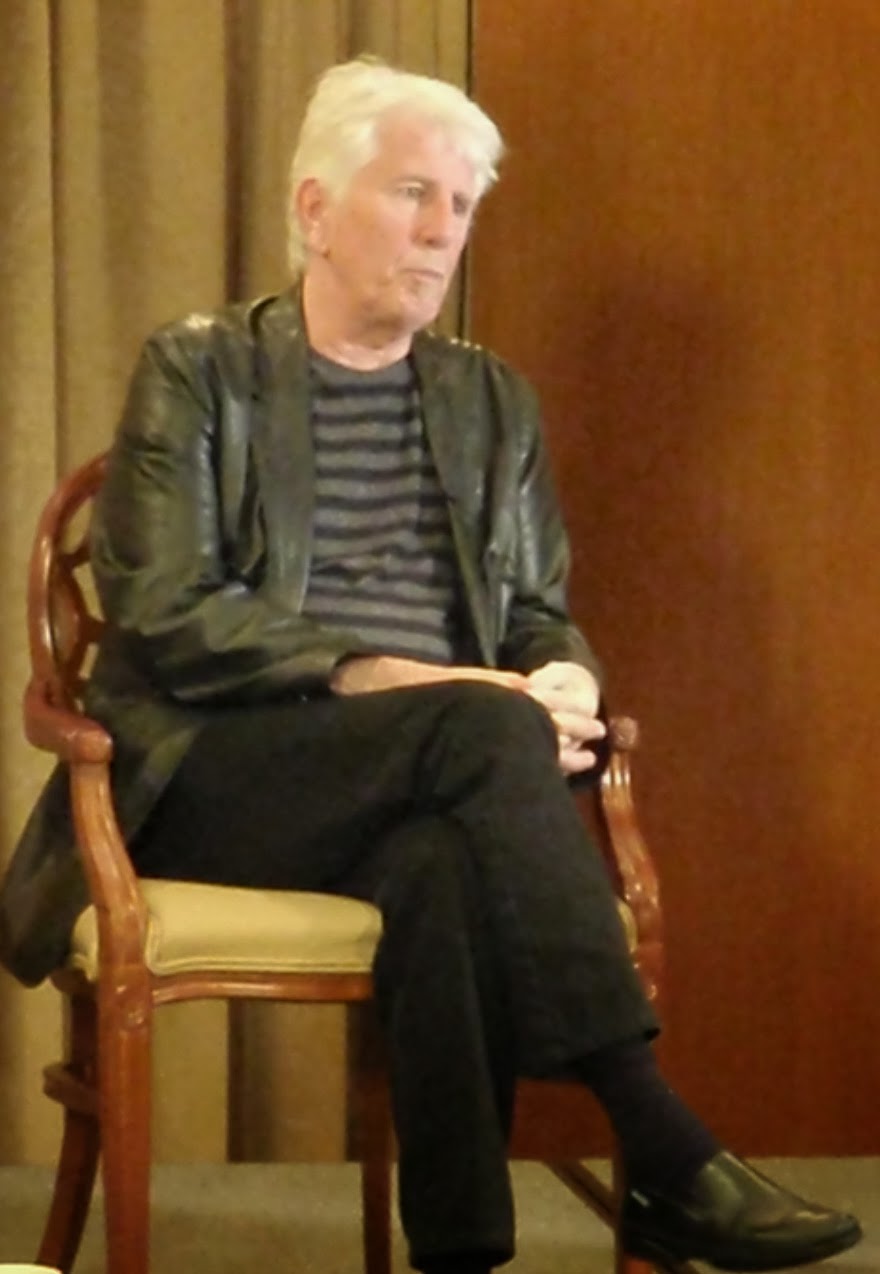
Graham Nash Today: Discussing his memoir at the Library of Congress
Crosby, then a member of the Byrds, introduced Nash to Stephen Stills, who at the time was a member of the Buffalo Springfield along with the enigmatic Neil Young. The trio decided to see how they would sound together. They started with a Stills song "You Don't Have to Cry". After hearing the song, Nash asked Stills and Crosby to sing it one more time. "We then hit that 3-part harmony and we all started laughing. It was great. What a thing to hear. Our sound was born in 40 seconds," Nash said.

"From the moment I heard me and David and Stephen sing, I wanted that sound," Nash said. "So what the hell was I supposed to do? I left my wife. I left my band. I left England and came to America".

But Nash, who will be 72 on his next birthday, readily credits England, his family, and his friend (and later Hollies band mate) Allen Clarke (whom he 1st met in school as a 6-year-old) with his musical beginnings.

"I have a vivid memory of blackout curtains (used in British homes during World War II)," Nash said. "After the war, it was a very strange existence. As youngsters we had nothing to do. At the time, you were supposed to grow up and do what your Dad did. But my mother and father never let me fall for that. I knew from the age of 13 that I wanted to be a rock and roll musician. I've actually been a photographer longer than I have been a musician. But I knew I couldn't get girls with a camera. That wasn't happening. Nobody was saying that's a sexy camera. But a guitar ..."

One of Nash's greatest influences were Don and Phil Everly. He and Clark found out they were performing in their city. "It was April, 1960 and we were dying to met them," Nash said. So they went to the show and then staked out the hotel where they were sure the Everly Brothers were staying. Finally, at 1:20 a.m., the brothers came down the street. Nash and Clark approached them. "They were great. They talked to us for 20 minutes. We were so happy. In many ways, we are all trying to touch the flame of that which we admire".  At the time, Nash never imagined that over the years he would actually get to perform and sing with his idols on several occasions.

Nash said he enjoyed his time with the Hollies, but came to disagree with their musical directions. The group wanted to continue focusing on making hit singles; Nash wanted more. "Being around those (California) people changed me. I learned you could write a song about real stuff and still sell records," he said.

Another seminal figure in Nash's musical development was Joni Mitchell. "How could you live with a genius and not have something rub off?" Nash said of the years he and Mitchell were a couple. In fact, Nash says he feels so fortunate to have found 2 great loves in life - Joni and his current wife of 37 years, Susan. "She keeps my feet on the ground," he said.

And then, of course, there's Crosby. "This guy never ceases to amaze me," Nash said. "He's probably on his 15th life, but I think he has finally realized that he is not invincible".

In fact, an incident involving one of Crosby's escapades was the only thing the publishers of Nash's book questioned. "Legal called me and said I had to check on the story that David sold his Mercedes for crack (cocaine). It seems David wanted to get his car back so he went to the dealer's house and found him dead from a drug OD (over dose). So David stole his pink slip back. When I asked him about the story, David said not only was it true, there was more. He actually resold the car again to get more crack".

Nash said he is constantly grateful for the life he has lived. "My father was dead at 46 and so sometimes, I feel I'm living 2 lives," he said. He said a few years ago, he asked his mother why she and his father had been so supportive of his choice to risk all with music. "You're living my life," she told him. After she died, Nash was playing a concert at Carnegie Hall in New York. "I scattered some of her ashes there he said, adding that he still does that whenever he performs on a stage he believes his mother would have liked to have sung.

As for the political nature of much of his songwriting, Nash again cites Crosby. "Crosby has always spoken truth to power. I've always been for the underdog. I think the media wants us to focus on (Justin) Bieber's monkey or the size of Kim Kardashian's ass, but music is so much more than that," he said.

Nash said that the political stands both he and the various configurations CSN&Y have assumed over the years, have effected the group's popularity. On their last tour together during the George W. Bush years, the band played a song "Let's Impeach the President". In some southern venues, that stance caused some of the crowd to walk out.  "I mean they have the right to walk out, but Holy Toledo, if you buy a ticket to a Crosby, Stills, Nash, and Young concert, what the heck do you expect?"

Like so many other great songwriters, Nash cannot offer a formula for what he does. "Once I write a song, it has to make it through me. I only write for me. I have to be moved before I can write," He explained. He did, however, note with a laugh, one time when the process was speeded up. "I was at a dinner party and somebody said, 'you're supposed to be a big star. I bet you can't write a song before you go," Nash noted. So he left the room and came back in about 20 minutes with a completed version of "Just a Song Before I Go".  The song reached #7 on the Billboard charts in 1977, making it CSN&Y's highest climbing hit. "Yes, I really do love what I get to do," Nash repeats. "I know so many people that have had their dreams crushed, but I get to live mine everyday".

Monday, September 23, 2013

Book Fans and Their Fest

There are probably as many reasons to attend the National Book Festival as there are attendees. However, the avid reading enthusiasts who yearly congregate on the National Mall for one of America's largest book celebrations can loosely be arranged in 1 of 3 categories - some come for a particular type of book, others come for a particular author or authors, and still others come to grab the free reading goodies offered, which includes large, brightly-colored book bags (this year orange) to carry those items home.

Margaret Atwood prepares to take the stage
Take Anne Rhome. The 67-year-old Virginia resident could be found Saturday on the 2nd row of chairs in the Fiction and Mystery tent, where she planned to spend the entire 7 hours of the festival, which is sponsored by the Library of Congress.

"I come here to hear the authors talk about both their new books and their older books," Rhome says. "I've only missed 1 (of the 12) festivals. I stay mostly in the fiction tent because that is what I read."

So how come she wasn't in the 1st row? You could blame her late arrival for not getting the closest seats. On this particular Saturday, the book festival started at 10 a.m.with an appearance by Dom DeLillo, one of America's most acclaimed writers. In 2006, a New York Times survey of writers and literary experts chose his novel Underworld as the 2nd best novel of the past 25 years. When Rhome arrived shortly after 9 a.m., she was told the front row had been filled by 8:45.

Rhome says she never tires of the DC festival, which allows her to continue her life-long passion with books and reading. "When I was young, I loved being in the library and being surrounded by books," she said.

Then there are readers like Carolyn Hoy, a high school teacher who had traveled with 2 friends from Lancaster, Pa. for Saturday's programs. There were 2 reasons she was there - one was named Margaret Atwood; the other was Daniel Pink. In fact, we encountered Hoy as she was taking pictures of Pink, who was minutes away from delivering an engaging talk on his newest book entitled To Sell Is Human: The Surprising Truth About Persuading, Convincing, and Influencing Others.

"Don't you just love him," Hoy said as she snapped away. As a teacher, she readily agrees with Pink's contention that everyone is a salesmen and therefore should know the best ways to persuade and convince.
"I use all of his books in class," says Hoy, who teaches seminar classes to mixed groups of gifted students in grades 9 through 12. She said Pink's works are ideal for learning concepts of creativity and motivation.

As Pink prowled the stage animatedly distributing the wisdom he had gathered from social scientists around America, you could spot Hoy furiously scribbling down ideas to take back to her classroom.


Daniel Pink persuades fans like Hoy
In the final category you would be hard pressed to find a better example than my wife (and doting grandmother of our 2 grandkids, 5-and-half-year-old Audrey and 4-year-old Owen). Now while Judy did plan to see some authors (her 2 choices for this Saturday were Linda Ronstadt with her new memoir Simple Dreams and Christina Garcia, a Cuban-American writer whose latest book is a darkly comic novel featuring a fictionalized Fidel Castro entitled King of Cuba) that wasn't her main reason for her attendance.

Just a portion of my wife's free reading haul.
For much of the day, you could find Judy prowling the tents, filling her bright orange book bag with age-appropriate, reading-related materials for Audrey (who is already reading on her own) and Owen (who still prefers to be read to).

"I love the festival because they have a lot of fun, free, educational things that you can take home for your children or your grandchildren," Judy said. "And a lot of the items you couldn't even buy in stores if you wanted to".

My wife says she can't wait to bring Audrey and Owen (who currently live in suburban Atlanta) to the festival. I support that idea. Maybe then they can carry their own bags. But until that day comes, that is a task for Grandpop. Thank goodness I love books and my grandkids and I look good in orange.

Tales, Tidbits, and Tips
To book lovers, the National Book Festival is like a rock festival. But like the New Orleans Fest or Bonaroo, the multiple-stages setup prompts some tough decisions. Here are some I faced this past weekend ... Linda Ronstadt or Dom DeLillio? .... James McBride or Daniel Pink? ...Terry McMillan or Benjamin Percy? Alfredo Corchado or Joyce Carol Oates? Taylor Branch (whom I have seen before) or lunch? What a wonderful problem to have.

Sunday, September 22, 2013

The National Book Festival In Pictures


The Library of Congress held its 12th annual National Book Festival on the National Mall this past weekend. The 2-day event brought more than 100 authors to thousands of avid book readers of all ages. This post will show you some of what it was like to be there.

The Schedule 


A Sampling of Authors

Linda Ronstadt

Margaret Atwood

Brad Meltzer

Taylor Branch
Daniel Pink

Justin Cronin

Benjamin Percy

Christoper Buckley

Alfredo Corchado

Kenneth Mack

What Older Readers Did


And What Younger Readers Did


Tales, Tidbits, and Tips
This is the 1st in a 5-part series on the National Book Fest.  Still to come:
  • An inside look at why people attend the festival
  • Titling a novel satirist Christopher Buckley
  • The day as seen by Book Fest veteran and NY Times best selling author Brad Meltzer
  • Festival newbie from Mexican-American journalist Alfredo Cortazar.

Sunday, July 14, 2013

The Library of Congress Looks at the Civil War

The Myriopticon, A Historical Panorama of the Rebellion. Springfield, Massachusetts: Milton Bradley Company, [before 1890]. Alfred Whital Stern Collection, Rare Book and Special Collections Division, Library of Congress 
Some historians say that the outcome of the Civil War was never in serious doubt from the time the 1st shots were fired at Fort Sumter. The urban North was simply too powerful and populated for the agrarian South to win. It was a mathematical question of more men, more munitions, and more mechanization. You can even see the vast difference in capabilities of the 2 regions by perusing the school texts of young students. While the 80 different textbooks published in the Confederacy during the times of the conflict were simple black and white books on cheap paper, their counterparts in the North were replete with colorful illustrations and drawings.

The Northern texts were also much better at a not-so-subtle use of propaganda to promote patriotism and the Union cause. Take, for example, the words of these 2 pages from The Union ABCs.

Q is for Quarters, guarded with care
R is for Retreat, may you never be there
S is for Sailor who respected will be
T is for Traitor, that was hung on a tree.

Samples of the textbooks are just some of the more than 200 items now on display at the Library of Congress for its exhibition The Civil War in America.

A graphic timeline, adapted from the massive companion book to the exhibition, provides a chronological framework of wartime and postwar events.  Original documents that chart the course of the war are interwoven with personal pictures and eyewitness accounts and recollections that place the war in a human perspective.

Among some of the more interesting items displayed are:
  • the sheet music for "The Palmetto State," a song composed to celebrate the fact that South Carolina was the 1st state to secede from the Union
  • The Confederate States Medical and Surgical Journal which, since medicine was in short supply in the South, offers ways to use indigenous plants, herbs, and berries for treatments
  • the haversack that poet Walt Whitman carried as he visited the wounded Union soldiers in DC. Also on display is Whitman's notebook where he described "the heap of feet, legs, arms, human fragments, cut, bloody, black and blue, swelled and sickening" he found at a battle site
  • an 1863 broadside from the Workingmen's Democratic Republican Association headlined "To the Working Men of New York ... Stop and Think ... Stand by the Law" which was published to urge men to not riot and honor the draft for additional soldiers
  • playing cards with Union emblems provided to Northern soldiers to promote "liberty and loyalty"
  • a copy of Abraham Lincoln's famed Gettysburg Address
  • a minnie ball extracted from a wounded soldier
  • a copy of CSA (the Confederate States of America) 1865 Senate Bill which was "to provide for the Raising of Two Hundred Thousand Negro Troops"
  • the contents of Abraham Lincoln's pockets on the night he was assassinated which included a pocket knife, 2 pair of glasses, and a $5 Confederate bill
  • an April 20, 1865 poster from the War Department offering a $100,000 reward for the murderer of President Lincoln
Tales, Tidbits, and Tips
You have plenty of time to visit the exhibition. It is scheduled to run until Jan. 4. However, if you won't be able to make it to DC or you want to get a preview of what you will see, you can do so by clicking here.

Sunday, June 30, 2013

Touring DC: In the Steps of the Civil War

July annually means the start of the summer tourist season in DC. This year, 4 historic anniversaries are being celebrated in the nation's capital: the 150th anniversary of the Civil War, the 150th anniversary of the Emancipation Proclamation, the 50th anniversary of the March on Washington and Martin Luther King's I Have a Dream speech, and the 50th anniversary of the assassination of President John F. Kennedy. To commemorate the 4 events, The Prices Do DC has designed a full-day tour featuring monuments and museum exhibitions selected to help you know more about the people and events of the times. Today's tour:  DC and the Civil War.


Morning

Arlington National Cemetery
Your main stop here is the Arlington House, the former home of Confederate General Robert E. Lee. To learn more click here. Free. (Metro - Arlington Cemetery Station - Blue Line)


Fort Stevens
Throughout the Civil War, only the width of the Potomac River separated Washington from enemy territory. Yet only once - on July 11, 1864 did the Confederate Army enter the city limits and it was repelled in a 2-day battle here. To learn more click here. Free. (Metro - Takoma Station - Red Line)

Afternoon


Library of Congress - The Civil War in America
The Civil War in America assembles more than 200 unique items, many of which have never been seen by the public, to commemorate the sesquicentennial of this nation's greatest military and political upheaval. To learn more, click here. Free. (Metro - Capitol South - Blue Line)


Newseum - Blood and Ink
Blood and Ink: Front Pages From the Civil War showcases more than 30 historic front pages from the Newseum's collection spanning the length of the war, from the birth of the Confederacy to the death of President Abraham Lincoln. To learn more, click here. Admission fee good for 2 days.  (Metro - Yellow Line - Archives)

Early Evening


African American Civil War Memorial
Throughout the course of the American Civil War over 200,000 African American soldiers and sailors served to keep the United States whole and to free permanently over four million people in forced servitude.  The memorial honors the service and sacrifices of the more than 200,000 African American veterans who fought to free more than 4 million of their people enslaved in the South. To learn more, click here.  Free. (Metro - Yellow or Green Line - U Street)

Related Dining Experiences for Lunch or Dinner
  • Old Ebbitt Grill (DC's oldest ongoing restaurant established in 1856)
  • Southern cuisine: Georgia Brown's (low country meals - our favorite restaurant in DC), Vidalia (upscale southern - on many best 10 in DC lists), Acadiana (Cajun/Creole/New Orleans)
Tales, Tidbits, and  Tips
Here are some suggestions to help you get the most from this, or any, DC visit.
  • Consider staying in Crystal City, which is just across the Potomac, or a hotel/motel in Maryland near a Metro line. It is usually less expensive than staying in similar lodging in DC.
  • Leave your car at home or at your hotel/motel. We have lived in the DC-area for 2 years and have never driven in the district. Between the Metro, buses, and taxi cabs it is safe and easy to get around the city. DC is also extremely walkable.
  • You will have to be inspected and screened at most all museums and attractions. To save time, carry only what you absolutely need with you. 
  • In the summer, DC is hot and humid. Dress accordingly.
  • It doesn't hurt to download some DC apps on your smartphone. Our 5 top recommendations are DC Rider, Go Out from The Washington Post, Smithsonian, National Mall, and Yelp.
  • For more valuable suggestions and tips,check out our The Prices Do DC blog and website.

Monday, June 3, 2013

What Is the Grass?

And the words of the prophets (in this case Walt Whitman) are written on the Metro walls.
A few years ago, poet Mark Doty, who in 2008 won the National Book Award for Poetry, was in Nebraska to give a talk on American literary giant Walt Whitman. Arriving in town, Doty realized that he had forgotten  his copy of  Whitman's poetic masterpiece Leaves of Grass. So, he immediately went to the nearest used bookstore. "You can pretty much know that any used book store in America will have at least one copy of Leaves of Grass," Doty says

The particular copy he bought had been owned by a young college student. In the margins of Whitman's poem entitled "What Is the Grass?" she had written, in a long looping hand, "Isn't it grass?"

"It was a story of a mind at rest (the student's) and one that couldn't (Whitman's)," Doty says. "She believed words settled things. For him, (Whitman) the word settled nothing at all."

Walt Whitman
Doty, whose forthcoming book is entitled What is the Grass and will be a meditation on Whitman, was joined recently by DC poet Sally Keith at the Library of Congress to discuss the legacy of Whitman and his influence on their poetry.

"For a poet, he is our enormous, brilliant, and inescapable Uncle," Doty said. "He is the predecessor of us all. He asked the questions who are we and what does it mean to be part of the tribe, a part of the group? These have been with me my whole career."

Keith, who is also a professor in the creative writing program at George Mason, talked at length about Whitman's ties to Washington. Whitman, who spent most of his years in New York and New Jersey, arrived in Washington to look for his brother, George, who had been wounded during the Civil War. He stayed for 10 years taking care of wounded war veterans.

"I think of Whitman, sitting in the window of the hospital (which is now the Smithsonian Portrait Galley), looking out at the city," Keith said. She said you can take a walking Whitman literary tour in DC "which even, for some reason, has you have lunch at the Hard Rock Cafe." One of the highlights of that tour is the inscription of lines from Whitman's poetry that you encounter after a long escalator ride up to the exit of the Dupont Circle Metro station.
Thus in silence in dreams' projections,

Returning, resuming, I thread my way through the hospitals;

The hurt and wounded I pacify with soothing hand,

I sit by the restless all dark night - some are so young;

Some suffer so much - I recall the experience sweet and sad...

Walt Whitman, from Leaves of Grass, 1876
"Whitman, while in Washington, hoped for a national union. He wrote about the ebb and flow of human existence and the world of contradictions," Keith said.

Whitman, in 1855, became famous after self-publishing the 1st edition of Leaves of Grass, his major work which he continually revised and enlarged during the rest of his life. At the time, the book garnered much controversy for its free-verse style and frank treatment of sexuality. However, it is now heralded as one of the foundational texts in American literature and is celebrated for its patriotism and visionary humanism. Fellow American literary giant Ralph Waldo Emerson called the book of poetry "the most extraordinary piece of wit and wisdom America has yet contributed."

Tales, Tidbits, and Tips
The special program took place on May 31st, the date of what would have been Whitman's 194th birthday. The event was the next to last in the Library of Congress' special celebrations of the birthdays of noted American writers. The final event for this season, devoted to the life and writings of African-American poet Paul Laurence Dunbar, will be held on June 27th.

Popular Posts